Introduction
Accounting has always been regarded as the language of business. Every financial transaction, business decision, investment strategy, and compliance requirement depends on accurate financial records. For centuries, accounting relied heavily on manual calculations, paperwork, spreadsheets, and repetitive processes. Even after the introduction of accounting software, professionals still spent countless hours entering data, reconciling bank statements, processing invoices, and preparing financial reports.
However, the accounting industry is now experiencing its biggest transformation in decades. Artificial Intelligence is changing not only how accounting tasks are completed but also how accountants contribute to business growth.
Instead of spending valuable time on repetitive work, finance professionals can now focus on strategic planning, financial analysis, forecasting, risk management, and business advisory services. AI systems can process millions of financial records within minutes while maintaining exceptional accuracy.
The rise of cloud computing, machine learning, robotic process automation (RPA), optical character recognition (OCR), and predictive analytics has accelerated this transformation. Companies that once required large accounting teams can now automate a significant portion of their financial operations.
This is not about replacing accountants—it is about empowering them.
Businesses that embrace AI are becoming faster, more efficient, and better equipped to compete in an increasingly digital economy.
What is AI in Accounting?
Artificial Intelligence in accounting refers to the use of intelligent technologies capable of performing tasks that traditionally required human intervention.
These technologies include:
Machine Learning (ML)
Natural Language Processing (NLP)
Robotic Process Automation (RPA)
Optical Character Recognition (OCR)
Predictive Analytics
Intelligent Data Processing
Unlike traditional accounting software that follows fixed rules, AI continuously learns from financial data, identifies patterns, detects unusual transactions, predicts future outcomes, and improves its performance over time.
For example, instead of manually entering hundreds of invoices into an accounting system, AI can automatically scan invoices, recognize vendor information, categorize expenses, verify tax calculations, and post entries into the ledger within seconds.
This level of automation significantly reduces human error while improving productivity.
Why AI is Becoming Essential in Modern Accounting
Today's business environment is more complex than ever before.
Companies generate enormous amounts of financial data every day through:
Sales transactions
Online payments
Vendor invoices
Payroll
Tax filings
Bank statements
Expense reports
Inventory management
Managing this volume of data manually has become nearly impossible.
Artificial Intelligence solves this challenge by processing large datasets instantly while maintaining high accuracy.
Instead of spending hours reviewing spreadsheets, finance teams receive intelligent dashboards that highlight trends, anomalies, cash flow forecasts, and financial risks.
Businesses can now make informed decisions based on real-time insights rather than outdated monthly reports.
How AI is Transforming Accounting
1. Automated Bookkeeping
Bookkeeping has traditionally been one of the most time-consuming accounting functions.
AI-powered accounting software can now:
Record transactions automatically
Categorize expenses
Match receipts
Reconcile bank accounts
Process journal entries
Maintain ledgers
This reduces manual work while ensuring greater consistency across financial records.
2. Intelligent Invoice Processing
Processing invoices manually often leads to delays, duplicate entries, and payment errors.
AI-powered OCR technology extracts information directly from invoices.
It can automatically identify:
Vendor name
Invoice number
Invoice date
Tax amount
Due date
Purchase order
Payment terms
The extracted data is then verified and posted into accounting software without human intervention.
3. Bank Reconciliation
Reconciling bank transactions is one of the most repetitive accounting tasks.
AI compares bank statements with accounting records in real time.
It can identify:
Missing transactions
Duplicate payments
Incorrect entries
Unmatched deposits
Fraudulent activities
What previously required several hours can now be completed in minutes.
4. Fraud Detection
Financial fraud continues to cost businesses billions of dollars every year.
Artificial Intelligence continuously monitors financial transactions and identifies suspicious activities based on behavioral patterns.
Examples include:
Duplicate invoices
Unauthorized payments
Fake vendors
Abnormal transactions
Expense manipulation
Unlike manual audits that occur periodically, AI monitors financial activities continuously.
5. Predictive Financial Analytics
One of AI's greatest strengths is its ability to forecast future outcomes.
Instead of simply reporting historical financial performance, AI predicts:
Cash flow
Revenue growth
Future expenses
Customer payment behavior
Inventory requirements
Business risks
These predictions enable management to make proactive decisions rather than reactive ones.
6. Tax Compliance and Reporting
Tax regulations continue to evolve every year.
AI helps businesses remain compliant by:
Monitoring tax law changes
Calculating taxes automatically
Identifying deductions
Preparing tax reports
Reducing filing errors
This minimizes penalties while saving valuable time during tax season.
Benefits of AI in Accounting
Improved Accuracy
Human error remains one of the biggest challenges in accounting.
AI significantly reduces mistakes caused by manual data entry, calculation errors, and duplicated transactions.
Accurate financial data leads to better business decisions.
Higher Productivity
Routine accounting work consumes a large portion of an accountant's time.
Automation allows professionals to complete repetitive tasks within minutes.
This increases overall productivity across finance departments.
Cost Reduction
Automation reduces operational costs by minimizing manual labor, correcting fewer errors, and improving workflow efficiency.
Small businesses especially benefit from lower accounting expenses.
Real-Time Financial Insights
Traditional accounting reports often become available weeks after transactions occur.
AI provides real-time dashboards showing:
Profitability
Cash flow
Revenue
Expenses
Financial trends
Business leaders can respond immediately to changing market conditions.
Better Decision Making
Data-driven businesses outperform competitors.
AI helps executives understand financial trends and predict future opportunities using intelligent analytics.
This leads to smarter investments and stronger financial planning.
Enhanced Compliance
Financial regulations continue becoming stricter.
AI ensures accounting records remain accurate, complete, and audit-ready.
This reduces compliance risks significantly.
Challenges of AI Adoption
Despite its benefits, AI implementation is not without challenges.
High Initial Investment
Implementing AI solutions requires investment in software, cloud infrastructure, training, and system integration.
However, long-term savings usually outweigh initial costs.
Data Security
Financial information is highly sensitive.
Organizations must ensure strong cybersecurity measures when adopting AI-powered accounting platforms.
Encryption, access controls, and regular monitoring become essential.
Employee Resistance
Many professionals fear automation will replace their jobs.
In reality, AI changes job responsibilities rather than eliminating them.
Accountants who develop analytical and advisory skills become even more valuable.
Need for Continuous Learning
Technology evolves rapidly.
Accounting professionals must continuously learn:
AI tools
Data analytics
Business intelligence
Automation software
Cloud accounting
Lifelong learning is becoming essential.
Skills Future Accountants Need
The role of accountants is shifting from data entry to strategic consulting.
Future finance professionals should develop skills including:
Financial analysis
Critical thinking
Data visualization
Business advisory
AI literacy
Communication
Problem solving
Cloud accounting
Risk management
Strategic planning
Technical expertise combined with business understanding will define successful accountants in the coming decade.
Industries Benefiting from AI Accounting
AI is transforming accounting across nearly every industry.
These include:
Banking
Healthcare
Manufacturing
Retail
E-commerce
Logistics
Construction
Real Estate
Education
Technology
Hospitality
Government
Regardless of industry size, AI improves financial efficiency and decision-making.
Will AI Replace Accountants?
This remains one of the most frequently asked questions.
The answer is No—but it will replace outdated accounting processes.
AI excels at repetitive, rule-based tasks.
However, it cannot replace human qualities such as:
Professional judgment
Ethical decision-making
Strategic planning
Client relationships
Negotiation
Leadership
Business consulting
Instead of replacing accountants, AI enables them to become financial advisors and strategic partners.
The accountants who embrace AI will have more opportunities than those who resist technological change.
The Future of Accounting Beyond 2026
The future of accounting will become increasingly intelligent, automated, and data-driven.
Emerging innovations will include:
Autonomous accounting systems
AI-powered financial assistants
Real-time auditing
Continuous compliance monitoring
Voice-enabled accounting
Blockchain integration
Predictive taxation
Hyper-automation
Digital CFO platforms
Finance departments will transition from reporting historical data to predicting future business outcomes.
Organizations will increasingly rely on AI for strategic financial management.
Conclusion
Artificial Intelligence is reshaping the accounting profession faster than any technological advancement in history. What once required days of manual effort can now be completed in minutes with greater speed, accuracy, and reliability. From bookkeeping and tax compliance to predictive analytics and fraud detection, AI has become a powerful partner for finance professionals.
The future belongs to accountants who embrace innovation rather than fear it. Success in the coming years will depend not only on technical accounting knowledge but also on the ability to leverage AI, interpret data, and provide strategic business insights.
As businesses continue their digital transformation, AI will no longer be considered an optional technology—it will become the foundation of modern accounting. Professionals who invest in learning these technologies today will lead the finance industry tomorrow, while organizations that adopt AI early will gain a significant competitive advantage in an increasingly data-driven global economy.
The future of accounting is not about humans versus AI—it is about humans empowered by AI.
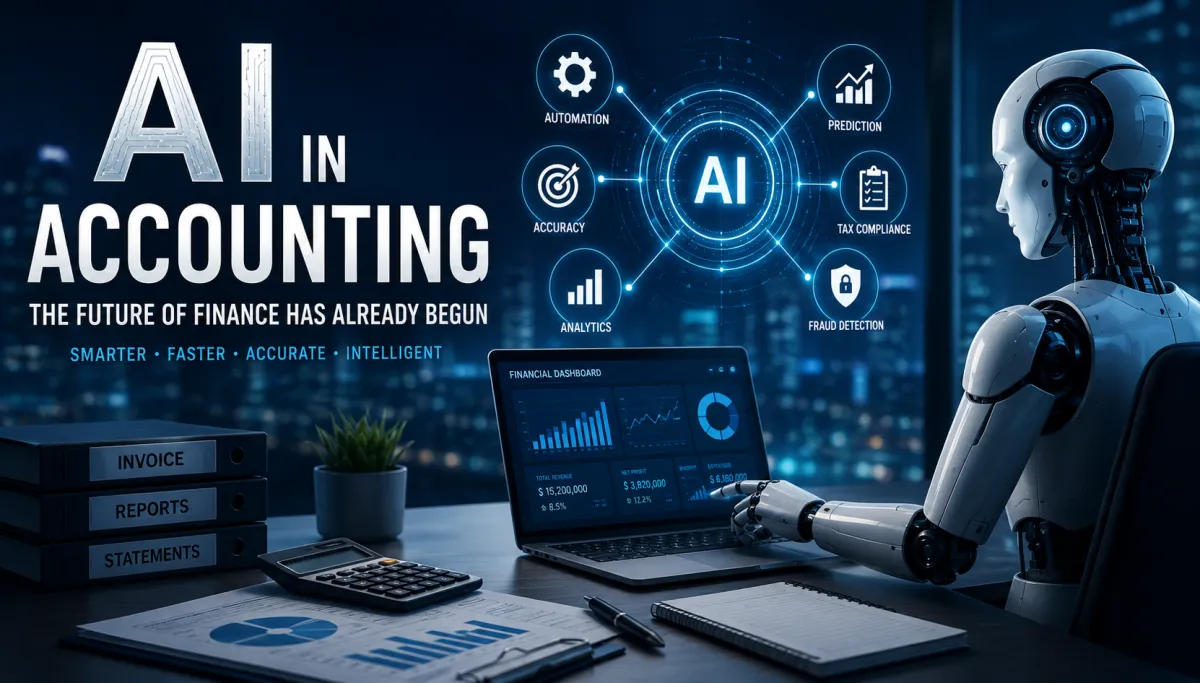
AI in Accounting 2026: The Future of Finance Has Already Begun

Manjeet saini
@ Mnjeet_saini
Short Summary
Artificial Intelligence (AI) is no longer a futuristic concept—it has become the driving force behind the evolution of the accounting profession. From automating repetitive bookkeeping tasks to delivering real-time financial insights, AI is transforming how businesses manage their finances. Organizations of every size are adopting intelligent accounting solutions to improve accuracy, reduce operational costs, strengthen compliance, and make faster, data-driven decisions.
This comprehensive guide explores how AI is revolutionizing accounting in 2026, the technologies behind this transformation, the benefits and challenges businesses face, and how accountants can adapt to remain valuable in an AI-powered world. Whether you are a finance professional, business owner, student, or entrepreneur, this article will help you understand why AI is becoming an indispensable part of modern accounting.
Artificial Intelligence (AI) is no longer a futuristic concept—it has become the driving force behind the evolution of the accounting profession. From automating repetitive bookkeeping tasks to delivering real-time financial insights, AI is transforming how businesses manage their finances. Organizations of every size are adopting intelligent accounting solutions to improve accuracy, reduce operational costs, strengthen compliance, and make faster, data-driven decisions.
This comprehensive guide explores how AI is revolutionizing accounting in 2026, the technologies behind this transformation, the benefits and challenges businesses face, and how accountants can adapt to remain valuable in an AI-powered world. Whether you are a finance professional, business owner, student, or entrepreneur, this article will help you understand why AI is becoming an indispensable part of modern accounting.



Comments (0)
Please login to comment.