A GST invoice is one of the most important documents under the Goods and Services Tax (GST) regime in India. It acts as legal proof of a taxable transaction between a supplier and a customer and forms the basis for tax collection, accounting, and Input Tax Credit (ITC) claims. Every GST-registered business is required to issue GST-compliant invoices for taxable supplies. Understanding the correct GST invoice format and its mandatory requirements is essential for ensuring compliance, maintaining transparency, and avoiding penalties.
A GST invoice should contain all the mandatory details prescribed under GST law. The invoice must clearly mention the supplier’s name, business address, GST Identification Number (GSTIN), and a unique invoice number. The invoice date should also be mentioned accurately to establish the timing of the transaction. These details help identify the supplier and ensure proper reporting during GST return filing.
The invoice should also include the recipient’s name, address, and GSTIN wherever applicable. For business-to-business (B2B) transactions, accurate customer details are particularly important because they enable the recipient to claim eligible Input Tax Credit. Incorrect or incomplete customer information may result in mismatches during GST reconciliation and affect ITC eligibility.
A proper description of the goods or services supplied should be included in every GST invoice. Businesses should mention the product or service name, quantity, unit of measurement, HSN (Harmonized System of Nomenclature) code or SAC (Services Accounting Code), taxable value, applicable GST rate, and the tax amount charged. Depending on the nature of the transaction, the invoice should separately display CGST, SGST, IGST, or UTGST wherever applicable.
For transactions within the same state, Central GST (CGST) and State GST (SGST) are generally applicable. For interstate transactions, Integrated GST (IGST) is usually charged. Businesses should determine the correct tax based on the place of supply and other applicable GST provisions to ensure accurate compliance.
The invoice should also mention the total taxable value, total GST amount, and the final invoice value payable by the customer. Where required, additional information such as reverse charge applicability, place of supply, transportation details, or digital signature may also be included according to GST regulations.
Issuing GST-compliant invoices is essential for businesses because customers rely on these invoices to claim Input Tax Credit. Any error in GSTIN, invoice number, tax amount, or taxable value may lead to rejection of ITC claims and create unnecessary disputes. Therefore, businesses should carefully verify all invoice details before issuing them.
Maintaining proper invoice records is equally important. Businesses should preserve tax invoices, debit notes, credit notes, revised invoices, delivery challans, and other supporting documents for the period prescribed under GST law. Organized documentation simplifies audits, tax assessments, financial reporting, and regulatory inspections.
Using modern accounting software can greatly simplify invoice preparation and management. Automated systems generate GST-compliant invoices, calculate taxes accurately, maintain sequential invoice numbering, integrate with inventory and accounting records, and assist in GST return preparation. Automation minimizes manual errors, improves efficiency, and supports better financial control.
Businesses should regularly review their invoicing process to ensure compliance with the latest GST rules and notifications. Since GST regulations may change over time, consulting a qualified Chartered Accountant or GST professional helps businesses remain updated with legal requirements and avoid costly compliance mistakes.
A properly prepared GST invoice is far more than a billing document—it is a key element of tax compliance, accounting accuracy, and financial transparency. By following the prescribed GST invoice format, maintaining accurate records, issuing invoices on time, and using reliable accounting systems, businesses can ensure smooth GST compliance, facilitate Input Tax Credit claims, strengthen customer confidence, and support sustainable business growth.
GST Invoice Format: Rules and Requirements Every Business Must Follow

Akshii
@ Manaksh
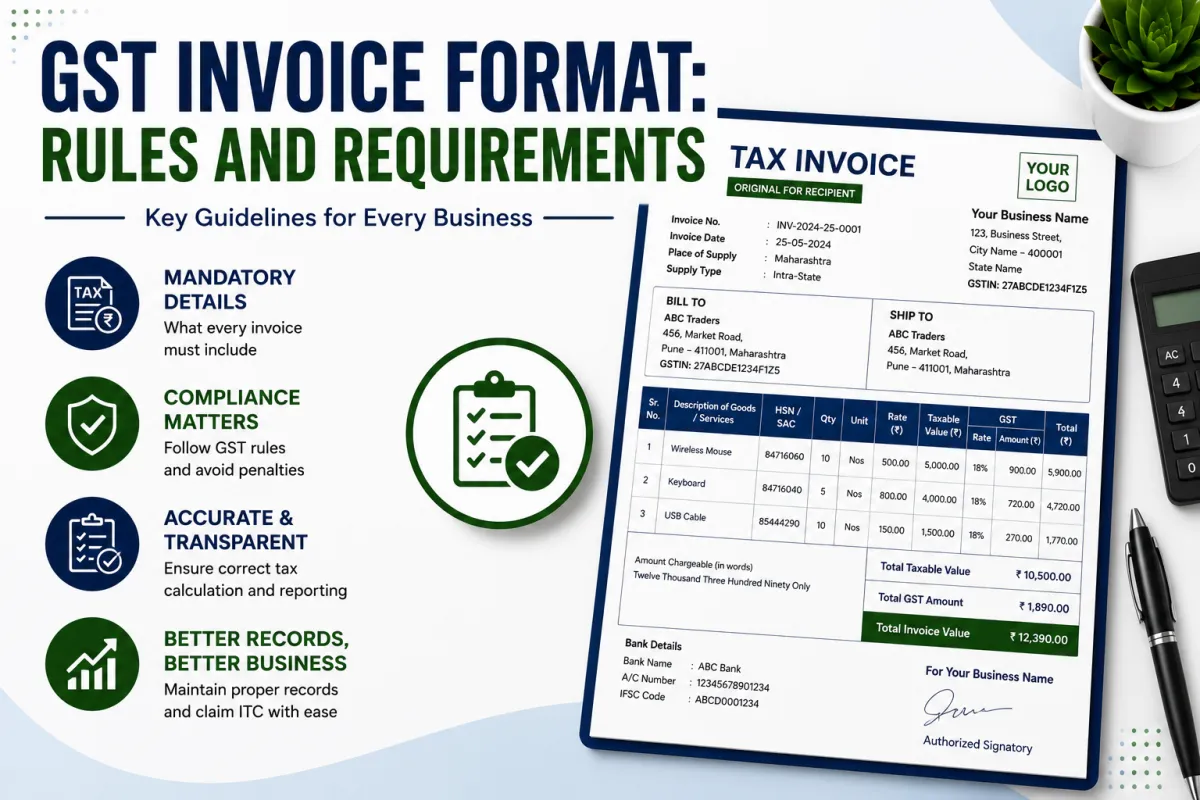
A GST invoice is a legally required document that records the supply of goods or services by a GST-registered business. Preparing invoices in the prescribed format ensures compliance with GST laws, supports Input Tax Credit (ITC) claims, and helps maintain accurate financial records.



Comments (0)
Please login to comment.