Remember the stereotypical image of an accountant? Hunched over a desk, surrounded by stacks of paper, meticulously checking numbers with a green eyeshade and a pencil? That image is as outdated as using a typewriter.
Accounting has undergone a massive transformation in recent years, driven by a powerful trifecta: Artificial Intelligence (AI), Machine Learning (ML), and automation. These technologies are fundamentally changing how financial data is collected, processed, and analyzed, and they are unlocking incredible potential for both accountants and the businesses they serve.
But let's be clear: this isn't about technology replacing accountants. Instead, it's about technology empowering them. The "modern accountant" is no longer just a number-cruncher; they are a strategic business advisor, a data interpreter, and a crucial player in driving sustainable growth.
The Shift: From Reactive to Proactive
Historically, accounting was largely reactive. Accountants recorded transactions, prepared financial statements after the fact, and helped with compliance and tax filings. This was, and still is, important work. However, the modern accountant has moved far beyond this traditional role.
Imagine the difference between a doctor who only treats a sickness and one who works with you to prevent illness in the first place. That’s the shift we’re seeing. Technology allows accountants to shift their focus from analyzing historical data to using that data to predict future trends and proactively manage financial health.
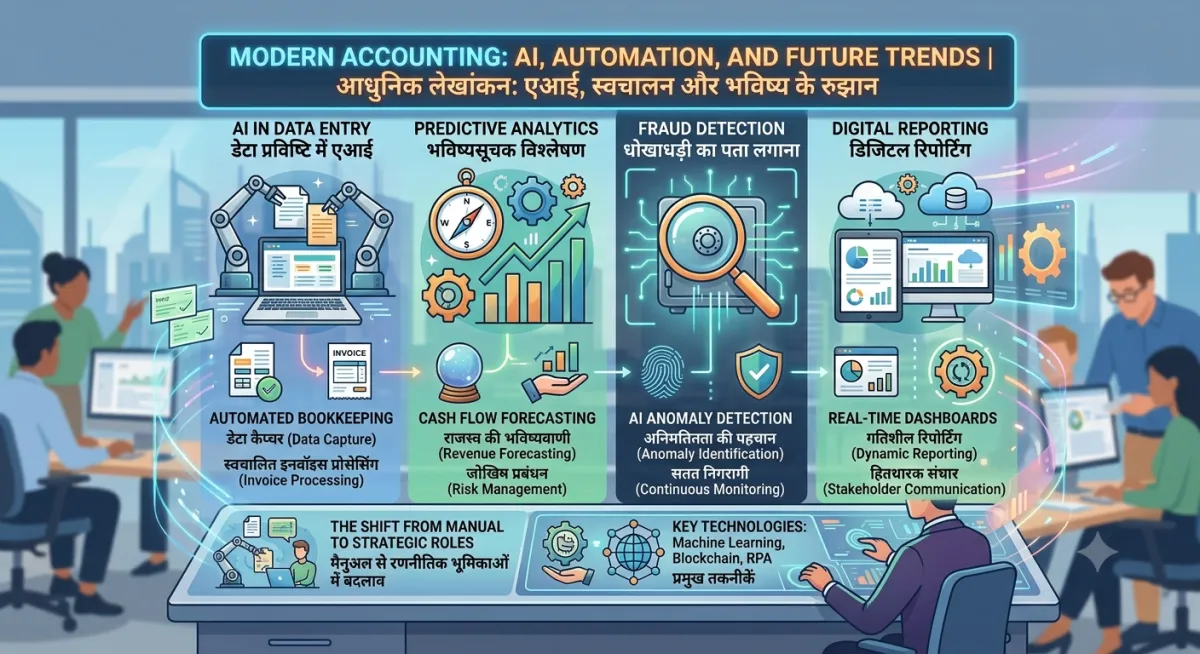
This proactive approach is built on the foundations laid out in our infographic
1. Revolutionizing Data Entry with AI
highlights the role of AI in data entry This is one of the most visible changes in modern accounting. No longer is valuable time spent manually inputting data from invoices, receipts, and bank statements. AI-powered tools can automatically capture this information with incredible accuracy, categorize transactions, and process invoices.
This automation:
Eliminates Manual Tasks: Frees up accountants from the drudgery of data entry.
Improves Accuracy: Reduces the human errors that can derail financial reporting.
Provides Real-Time Financial Visibility: Allows businesses to see their financial position at any given moment, not just at month-end.
This means accountants can move quickly to the next, more important step: interpretation.
2. Unleashing the Power of Predictive Analytics
Once the data is accurately captured and organized, the true power of modern accounting is unleashed through predictive analytics. As shown in this involves using sophisticated algorithms and machine learning models to analyze historical data and identify trends that can forecast future outcomes.
This allows accountants to provide invaluable guidance on:
Cash Flow Forecasting: Anticipating potential shortfalls or surpluses and advising on the best timing for major expenses.
Revenue Forecasting: Analyzing sales patterns and market factors to predict future sales and guide resource allocation.
Risk Management: Identifying potential financial risks (e.g., supply chain disruptions, changing regulations) and developing mitigation strategies.
3. Enhancing Fraud Detection and Security
Financial security is a paramount concern for any business. The digital age, while efficient, has also created new vulnerabilities. Modern accounting technology steps up to this challenge. AI-powered algorithms are constantly learning and evolving to identify unusual patterns or anomalies in financial transactions.
The fraud detection aspect in includes
Continuous Monitoring: Systems that never sleep, constantly scanning for red flags.
Anomaly Identification: Flagging suspicious transactions, duplicate invoices, or unusual changes in vendor behavior.
Strengthened Security Measures: Working alongside traditional controls to create a multi-layered defense.
This proactive approach to security provides peace of mind for business owners and ensures the integrity of their financial data.
4. The Era of Digital and Real-Time Reporting
The days of waiting weeks for financial reports are over. Technology has ushered in the era of digital and real-time reporting. Modern accounting platforms provide interactive dashboards and dynamic reporting tools that allow businesses to monitor their key performance indicators (KPIs) in near real-time.
As shown in the Digital Reporting column of this includes:
Dynamic Dashboards: Visual representations of financial performance that are easy to understand.
Instant Accessibility: Stakeholders can access financial information from anywhere, at any time.
Improved Communication: Facilitates more meaningful and timely communication between the accountant and the business owner.
This instant access to data allows for faster, data-driven decision-making, which is critical in today's fast-paced business environment.
The Most Critical Component: The Shift from Manual to Strategic Roles
This is the central theme that underpins everything. The infographic visualizes this as "The Shift from Manual to Strategic Roles" By automating mundane, repetitive tasks, technology is unlocking the time and capacity for accountants to use their critical thinking skills, financial expertise, and strategic insight.
The modern accountant becomes a:
Strategic Business Advisor: Using financial data to provide insights on everything from pricing strategy and cost reduction to merger and acquisition opportunities.
Business Performance Consultant: Helping to identify areas for operational improvement and optimizing resource allocation.
Growth Strategist: Developing financial models and forecasts that support expansion plans.
Technology Implementation Partner: Guiding businesses on the best financial and accounting software to meet their specific needs.
The Essential Skillset for the Modern Accountant
This new role requires a new skillset. While a strong foundation in accounting principles and regulations is still essential, the modern accountant must also possess:
Technology Proficiency: A deep understanding of accounting software, cloud platforms, data visualization tools, and emerging technologies like AI and RPA.
Data Fluency: The ability to not just access data but to interpret it, analyze trends, and communicate findings effectively.
Critical Thinking: The capacity to question data, identify underlying issues, and think creatively to solve complex problems.
Communication Skills: The ability to translate complex financial information into clear, actionable insights for non-financial stakeholders.
Adaptability: A commitment to continuous learning as technology and regulations evolve.
Conclusion: A Thriving Future for Accounting Professionals
The introduction of technology into the accounting field is not a threat. It is an opportunity. The future for accounting professionals who embrace this change is bright. By combining their core financial expertise with technology and strategic insight, the modern accountant will become an even more valuable and indispensable partner in driving business success.
The tools may have changed from pencils to algorithms, but the mission remains the same: to provide accurate financial information and strategic guidance that helps businesses thrive. The modern accountant, equipped with the technology and skills highlighted in is ready to lead the way.
Modern Accounting: A New Perspective

Manjeet saini
@ Mnjeet_saini
Tallying figures isn't all that's involved in accounting anymore. This blog delves into the exciting transformation that technology is bringing to the accounting field, making it more strategic, data-driven, and indispensable to business growth. We'll explore the shift from reactive to proactive accounting and highlight the critical skills that modern accountants need to succeed.

Comments (0)
Please login to comment.