Many entrepreneurs assume that a Trade License and GST Registration are the same because both are related to starting and operating a business. However, these registrations serve entirely different purposes and are issued by different authorities. Understanding the distinction between a Trade License and GST Registration is essential for every business owner to ensure legal compliance and avoid unnecessary penalties or operational disruptions.
A Trade License is a permission granted by the local municipal authority or relevant local body allowing a business to carry out a particular trade or commercial activity within its jurisdiction. The primary objective of a Trade License is to regulate businesses from the perspective of public health, safety, hygiene, and local governance. Depending on the nature of the business and local regulations, obtaining a Trade License may be mandatory before commencing operations.
GST Registration, on the other hand, is a tax registration issued under the Goods and Services Tax (GST) law. It enables eligible businesses to collect GST on taxable supplies of goods or services, claim eligible Input Tax Credit (ITC), and comply with various GST filing and payment requirements. Businesses required to obtain GST Registration must collect and deposit GST in accordance with applicable tax laws.
The authority issuing these registrations is also different. A Trade License is generally issued by the municipal corporation, municipal council, or local authority responsible for regulating business activities within a particular area. GST Registration is issued by the Goods and Services Tax authorities through the official GST registration process.
The purpose of each registration clearly highlights the difference between the two. A Trade License regulates whether a business is permitted to operate from a particular location or conduct a specific type of commercial activity. GST Registration, however, governs taxation on the supply of goods and services and ensures compliance with India’s indirect tax system.
The requirement for obtaining these registrations depends on the nature of the business. Certain businesses may require only a Trade License, while others may require only GST Registration. Many businesses require both, depending on their activities, turnover, location, and applicable legal provisions. Business owners should carefully evaluate all statutory requirements before commencing operations.
Maintaining compliance after obtaining these registrations is equally important. Businesses should renew Trade Licenses whenever required by the local authority and ensure timely filing of GST returns, payment of taxes, maintenance of invoices, and proper accounting records after obtaining GST Registration. Ongoing compliance helps businesses avoid penalties and maintain uninterrupted operations.
Proper bookkeeping supports compliance with both registrations. Businesses should maintain accurate financial records, invoices, tax documents, licenses, payment receipts, and statutory records. Organized documentation simplifies inspections, audits, renewals, and tax filings while improving financial transparency.
Using reliable accounting and compliance management software can help businesses manage GST compliance, maintain financial records, track renewal dates, generate invoices, calculate taxes, and organize statutory documents. Automation reduces manual errors and improves overall compliance efficiency.
Since licensing requirements and GST regulations may change periodically, entrepreneurs should remain updated with the latest legal provisions applicable to their business. Consulting a qualified Chartered Accountant, Company Secretary, or legal professional can help determine which registrations are mandatory and ensure that all compliance requirements are fulfilled correctly.
A Trade License and GST Registration serve different but equally important purposes in establishing and operating a business legally in India. While a Trade License authorizes a business to conduct its operations within a local jurisdiction, GST Registration enables eligible businesses to comply with indirect tax laws. Understanding the difference between these two registrations helps entrepreneurs meet legal obligations, avoid compliance issues, and build a strong foundation for sustainable business growth.
Trade License vs GST Registration: Understanding the Key Differences for Businesses

Akshii
@ Manaksh
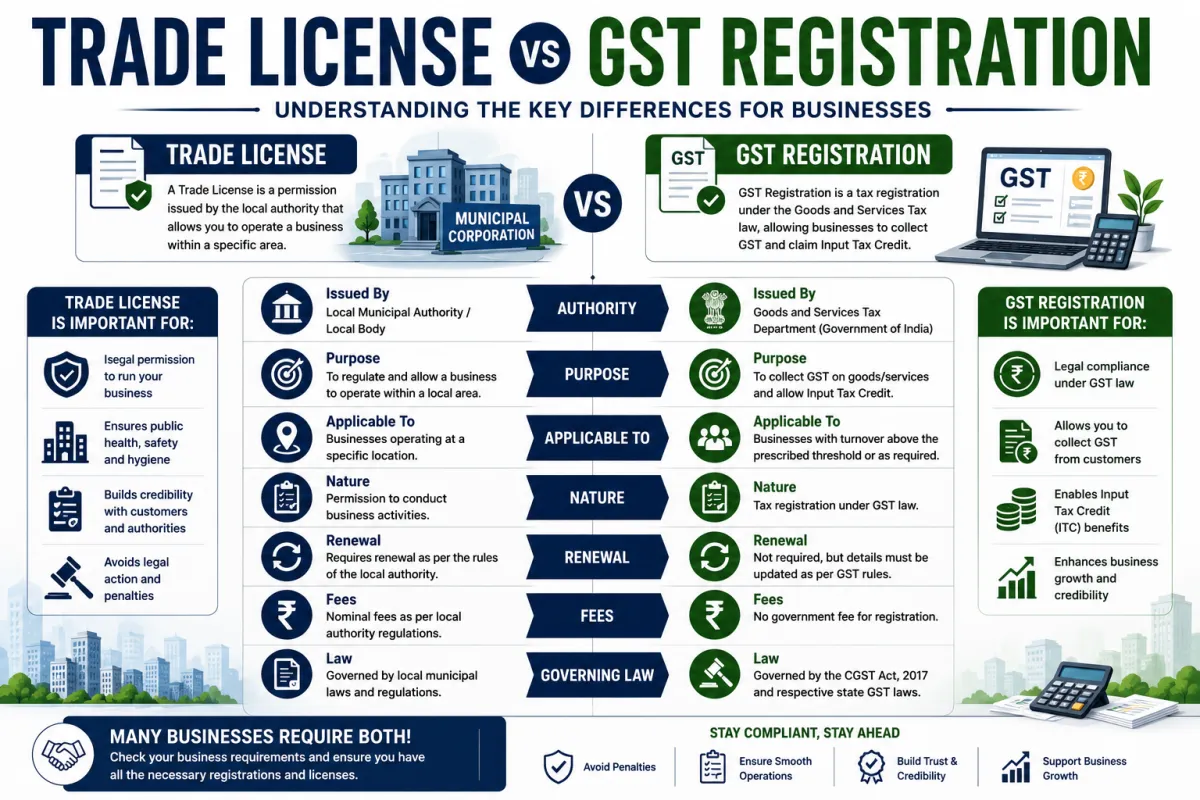
A Trade License and GST Registration are two different legal requirements for businesses in India. While a Trade License grants permission to carry on a specific business activity within a local jurisdiction, GST Registration is a tax registration required under the Goods and Services Tax law. Understanding the difference helps businesses comply with the appropriate regulations.


Comments (0)
Please login to comment.