Accounts Payable vs Accounts Receivable Explained

Akshita tyagi
@ tyagiakshita78@gmail.com
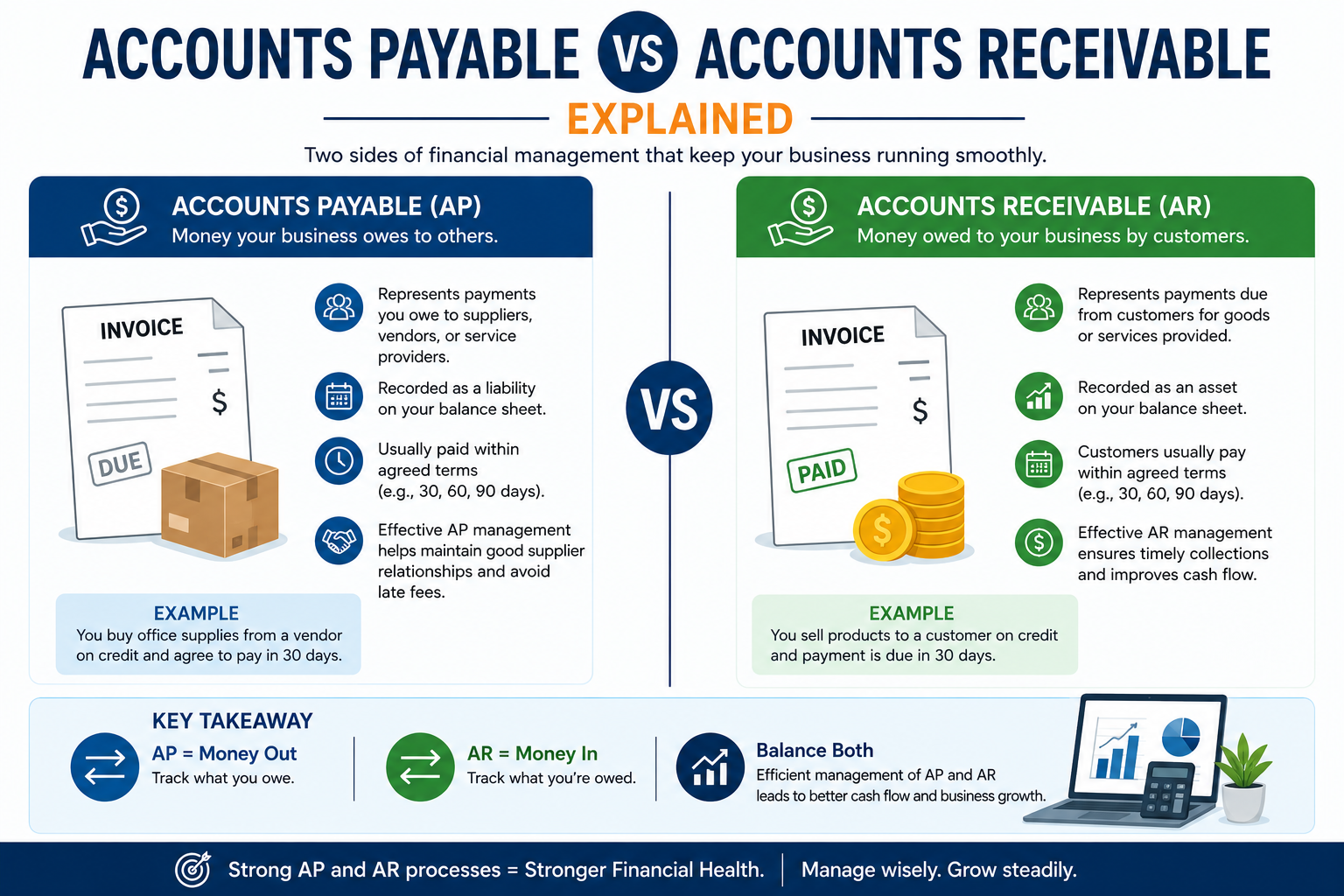
Accounts Payable (AP) and Accounts Receivable (AR) are two essential components of business finance. While Accounts Payable refers to money a business owes to suppliers, Accounts Receivable represents money owed to the business by customers.
Understanding the difference between Accounts Payable (AP) and Accounts Receivable (AR) is crucial for maintaining healthy business finances and effective cash flow management. Although both are key accounting functions, they serve opposite purposes within an organization. Accounts Payable refers to the money a business owes to its suppliers, vendors, or service providers for goods and services purchased on credit. These outstanding payments are recorded as liabilities on the company’s balance sheet because they represent financial obligations that must be settled within an agreed period. Effective management of Accounts Payable helps businesses maintain good relationships with suppliers, avoid late payment penalties, and manage cash flow efficiently. On the other hand, Accounts Receivable represents the money customers owe to a business for products or services provided on credit. These unpaid invoices are recorded as assets because they are expected to generate future cash inflows. Proper management of Accounts Receivable ensures timely collection of payments, reduces the risk of bad debts, and improves the company’s liquidity position. The primary difference between AP and AR lies in the direction of the payment. Accounts Payable tracks outgoing payments, while Accounts Receivable tracks incoming payments. Both functions play a vital role in determining a company’s financial health and operational efficiency. For example, if a company purchases office supplies from a vendor and agrees to pay within 30 days, the amount is recorded under Accounts Payable. Conversely, if the company sells products to a customer with payment due in 30 days, the amount is recorded under Accounts Receivable. Businesses must maintain a balance between these two processes to ensure sufficient cash flow for daily operations. Delayed collections in Accounts Receivable can lead to cash shortages, while poor Accounts Payable management may damage supplier relationships and impact business continuity. Modern accounting software and automation tools have made it easier for businesses to manage AP and AR processes through invoice tracking, automated reminders, payment scheduling, and real-time financial reporting. By understanding the roles and importance of Accounts Payable and Accounts Receivable, businesses can improve cash flow management, enhance financial planning, strengthen stakeholder relationships, and make informed decisions for long-term growth. Whether you are a startup, small business, or large enterprise, efficient AP and AR management is essential for maintaining financial stability and achieving business success.



Comments (0)
Please login to comment.