Bookkeeping and accounting are two essential functions that form the foundation of every successful business. Although the terms are often used interchangeably, they represent different stages of financial management. Bookkeeping focuses on recording and organizing financial transactions, whereas accounting involves interpreting, analyzing, summarizing, and reporting financial information for decision-making and statutory compliance. Understanding the difference between bookkeeping and accounting enables business owners to manage their finances more effectively and build a strong financial system.
Bookkeeping is the process of recording every financial transaction that occurs within a business. It includes maintaining records of sales, purchases, receipts, payments, invoices, expenses, payroll, bank transactions, and other day-to-day financial activities. The primary objective of bookkeeping is to ensure that all financial transactions are accurately recorded in chronological order. Proper bookkeeping creates the foundation upon which accounting activities are performed.
Bookkeepers are responsible for maintaining books of accounts, updating ledgers, recording journal entries, managing invoices, reconciling bank accounts, tracking accounts receivable and accounts payable, and preserving supporting financial documents. Accurate bookkeeping helps businesses maintain organized financial records, monitor cash flow, and prepare for audits and tax filing.
Accounting begins where bookkeeping ends. Accountants use the financial records prepared through bookkeeping to analyze business performance, prepare financial statements, calculate taxes, assess profitability, evaluate financial health, and provide strategic financial advice. Accounting transforms raw financial data into meaningful information that supports management decisions, business planning, budgeting, investment analysis, and regulatory compliance.
One of the major responsibilities of accounting is preparing financial statements such as the Balance Sheet, Profit and Loss Account, Cash Flow Statement, and other financial reports. Accountants also ensure compliance with accounting standards, tax regulations, GST provisions, TDS requirements, payroll laws, and other statutory obligations. Their work helps businesses meet legal requirements while improving financial transparency and stakeholder confidence.
Although bookkeeping and accounting perform different functions, both are equally important. Without accurate bookkeeping, accountants cannot prepare reliable financial reports. Similarly, without accounting, businesses cannot properly interpret financial information or make informed strategic decisions. Together, these functions ensure financial accuracy, operational efficiency, and long-term business sustainability.
Modern accounting software has significantly simplified both bookkeeping and accounting. Businesses can automate invoice generation, expense tracking, bank reconciliation, payroll processing, tax calculations, financial reporting, and document management. Automation reduces manual errors, improves efficiency, and provides business owners with real-time financial insights.
Maintaining organized financial records throughout the year benefits both bookkeeping and accounting activities. Businesses should preserve invoices, purchase bills, receipts, contracts, payroll records, bank statements, tax documents, GST filings, TDS records, and supporting financial documents. Proper documentation facilitates audits, tax assessments, financial reporting, and regulatory compliance.
Many growing businesses choose to work with professional bookkeepers and Chartered Accountants to ensure accurate financial management. Bookkeepers maintain daily financial records, while accountants provide higher-level financial analysis, tax planning, compliance support, and business advisory services. Together, they help organizations improve financial performance and achieve long-term business objectives.
Understanding the difference between bookkeeping and accounting enables entrepreneurs to appreciate the importance of both functions. Bookkeeping ensures that financial records remain complete and accurate, while accounting converts those records into valuable financial information for planning, compliance, and strategic decision-making. A business that invests in both accurate bookkeeping and professional accounting establishes a strong financial foundation that supports transparency, profitability, and sustainable growth.
Difference Between Bookkeeping and Accounting: A Complete Guide for Business Owners

Akshita tyagi
@ tyagiakshita78@gmail.com
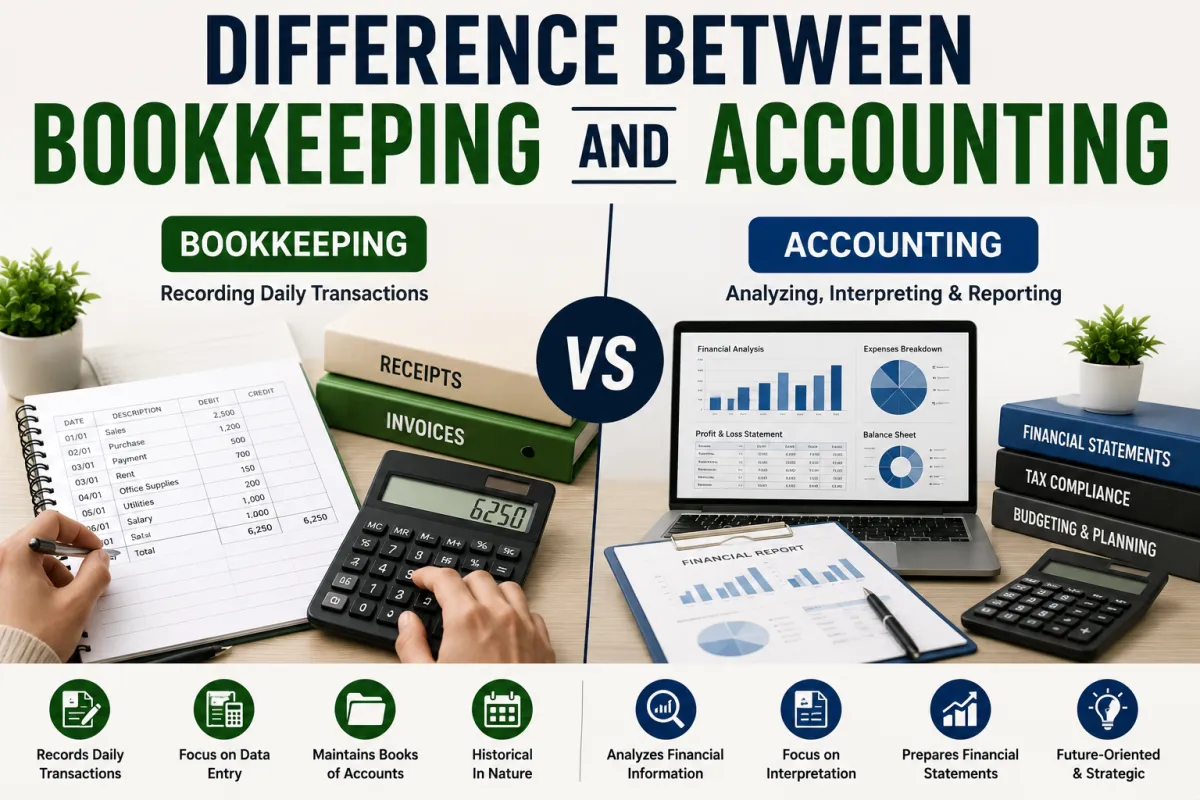
Bookkeeping and accounting are closely related but serve different purposes in financial management. Bookkeeping focuses on recording daily financial transactions, while accounting involves analyzing, interpreting, and reporting financial information to support business decisions and ensure regulatory compliance.



Comments (0)
Please login to comment.